How to Become a GTM Engineer in 2026: A Step-by-Step Roadmap
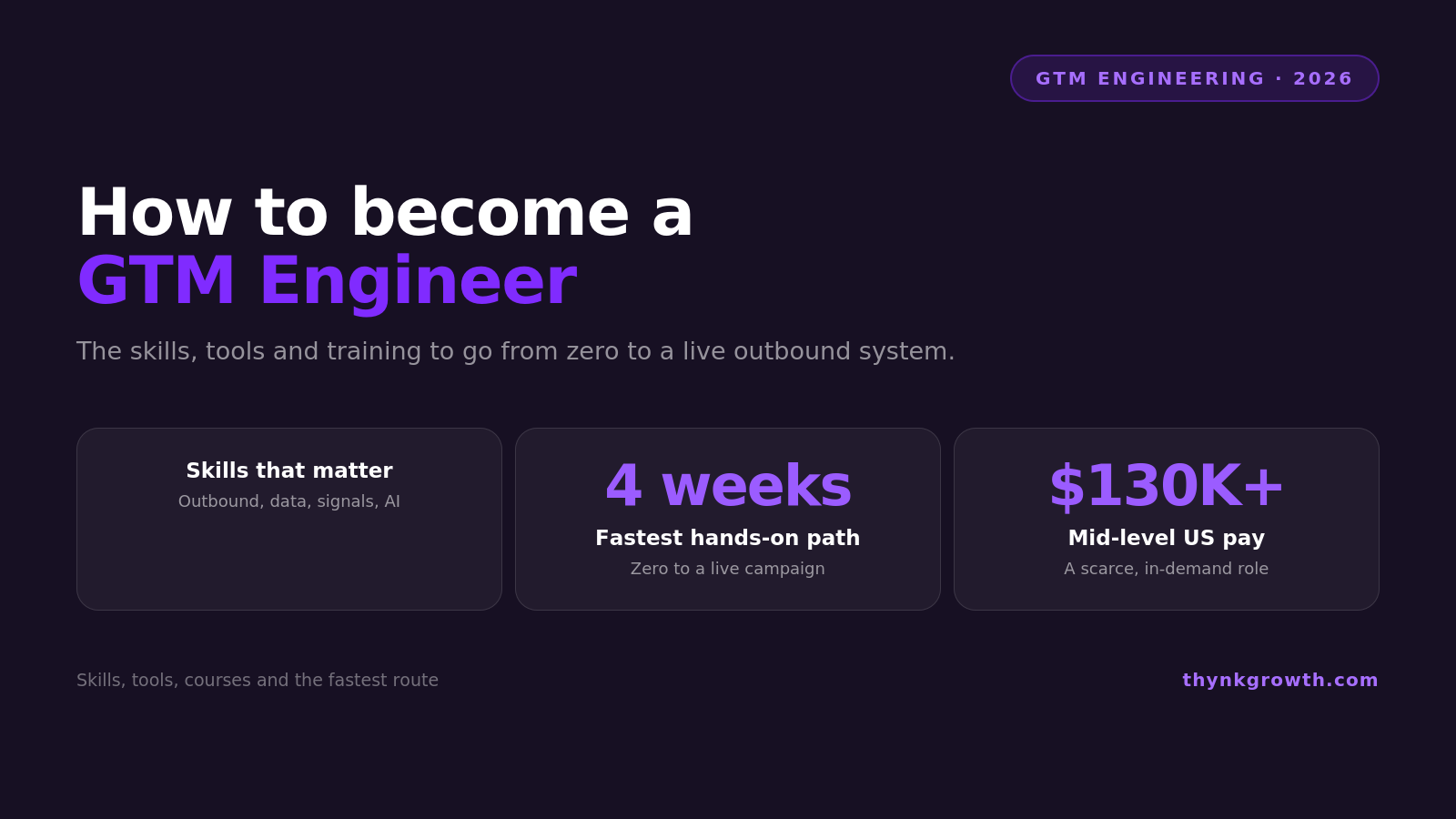
Quick answer: To become a GTM engineer in 2026, learn how B2B outbound works, set up sending infrastructure, get fluent in Clay for data enrichment, learn to act on buying signals, launch real campaigns, add AI as a build layer, and then prove it with a portfolio of two or three working systems. You do not need to code. Most people can build their first working system in 4 to 8 weeks and reach a hire-ready portfolio in about 90 days. Pay in the US runs roughly $100,000 to $130,000 at junior level and $180,000 and up at senior level.
I am a working GTM engineer. I built the outbound engine behind a $6.12M quarterly pipeline as the sole Clay operator for a 70-person BDR team at an enterprise SaaS company, I hold all four Clay certifications, and I have coached more than 20 people into the role through ThynkGrowth and our ThynkCrew cohort. This is the roadmap I actually see work, step by step.
- What does a GTM engineer do?
- GTM engineer vs RevOps vs SDR vs sales engineer
- Do you need to code to become a GTM engineer?
- What skills do you need to become a GTM engineer?
- How to become a GTM engineer: a step-by-step roadmap
- A 90-day plan to become a GTM engineer
- How to become a GTM engineer from your current role
- Portfolio projects that get you hired
- The tools to learn first
- Are GTM engineer certifications worth it?
- Self-study vs course vs coaching
- How much does a GTM engineer make?
- How I became a GTM engineer
What does a GTM engineer do?
A GTM engineer builds the systems a go-to-market team runs on. Instead of prospecting by hand, they build the machine that finds the right accounts, spots the buying signal that makes them worth contacting now, enriches the data, writes relevant messaging, protects deliverability and routes replies to sales.
It is a build role, not a reporting role. The demand is real: according to research from Clay and The Signal, 54% of the fastest-growing B2B SaaS companies have a GTM engineer. For the full definition, read what GTM engineering is and how B2B teams use it.
GTM engineer vs RevOps vs SDR vs sales engineer
The title gets confused with neighbouring roles. Here is how they differ:
| Role | Main job | Builds systems? | Typical tools |
|---|---|---|---|
| GTM engineer | Builds the automated pipeline: data, signals, outbound, routing | Yes, that is the job | Clay, Smartlead, HeyReach, CRM, Claude |
| RevOps | Runs CRM, reporting, forecasting and process | Sometimes, mostly CRM | Salesforce, HubSpot, BI tools |
| SDR | Prospects and books meetings by hand | Rarely | Sequencer, LinkedIn, CRM |
| Sales engineer | Runs technical demos and solution design for deals | No | The product, demo environments |
The short version: an SDR works the pipeline, RevOps reports on it, and a GTM engineer builds the machine that fills it.
Do you need to code to become a GTM engineer?
No. Modern GTM engineering is built with no-code tools and AI. If you can work in a spreadsheet, think in systems and debug calmly when something breaks, you can learn it. Basic comfort with APIs, webhooks and formulas helps, and a little SQL or JavaScript becomes useful later, but none of it is a requirement to start.
The background matters less than people think. Clay has noted that its own GTM engineers previously worked as investors, founders, structural engineers, software engineers, product managers and growth marketers.
What skills do you need to become a GTM engineer?
| Skill | What it means in practice | How to learn it |
|---|---|---|
| Outbound fundamentals | ICP, offers, sequences, what makes a prospect reply | Run one real campaign end to end |
| Deliverability | Domains, mailboxes, SPF, DKIM, DMARC, warmup | Set up your own sending domain |
| Data and enrichment | Finding contacts, waterfall enrichment, verification | Build enrichment tables in Clay |
| Signals | Funding, hiring, leadership changes, tech changes | Build one signal-triggered list |
| Copywriting | Short, specific emails tied to a signal | Write and test two angles |
| AI as a build layer | Connecting a model like Claude to live data via MCP | Automate one research step |
| Systems thinking | Seeing the whole pipeline, not one tool | Document every system you build |
How to become a GTM engineer: a step-by-step roadmap
Step 1: Learn how B2B outbound works
Before any tool, understand the motion: who the buyer is, what problem you solve, why now, and how a sequence turns a cold contact into a meeting. Read real cold emails, study why some get replies, and learn the basic metrics: reply rate, positive reply rate and meetings booked.
Step 2: Set up sending infrastructure
Buy a secondary domain, create a few mailboxes, configure SPF, DKIM and DMARC, and warm them up for two weeks. Every system you build later sits on this foundation, and hiring managers notice immediately whether you understand it. Our guide to setting up domains and mailboxes for cold email walks through it.
Step 3: Learn Clay and data enrichment
Clay is the centre of most GTM engineering stacks. Learn to pull a list, enrich it across several providers in a waterfall, verify emails, score accounts and push clean data to a CRM or sequencer. This is the single most valuable skill to get good at.
Step 4: Learn to act on buying signals
A filter tells you who could buy. A signal tells you who has a reason to reply this week: new funding, a new VP of Sales or Marketing, SDR roles posted, a tech stack change. Build one list from a single signal and you will understand why signal-led outbound beats static lists. See how to build a signal-led GTM system.
Step 5: Write and launch a real campaign
Write a short sequence tied to your signal, load it into a sequencer like Smartlead, and send it. Then read the results honestly: replies, positive replies and meetings. Launching is where most self-learners stop short, and it is the step employers care about most.
Step 6: Add AI as the build layer
Use AI to do the work a junior researcher would: summarise a company, find the signal, draft a first line, classify replies. Connecting a model like Claude to your data through MCP turns a static table into a system that thinks. Keep a human review step before anything sends.
Step 7: Build a portfolio and get hired
Document two or three systems you built: the goal, the stack, the workflow and the results. That portfolio does more for you than any certificate. Then apply based on the work a listing describes, not its title. Our guide to landing a GTM engineer job covers where the roles are.
A 90-day plan to become a GTM engineer
| Days | Focus | What you have at the end |
|---|---|---|
| 1 to 30 | Outbound basics, sending infrastructure, Clay fundamentals | A warmed domain and your first enriched list |
| 31 to 60 | Signals, copy, first live campaign, a LinkedIn channel | A live campaign with real reply data |
| 61 to 90 | AI automation, CRM sync, a second system, portfolio write-ups | Two documented systems and a portfolio to show |
Ninety days assumes 5 to 7 hours a week. Doing it with feedback from someone who has built these systems is what compresses it, because you skip the mistakes.
How to become a GTM engineer from your current role
From SDR or BDR
You already know the buyer and the motion, which is the hardest part to teach. Your gap is building: learn Clay, then automate the research and list-building you currently do by hand. SDR to GTM engineer is one of the most common paths into the role.
From RevOps or sales ops
You understand CRM, data hygiene and process. Your gap is the top of the funnel: deliverability, signals and copy. Run one outbound campaign end to end and you will have the full picture.
From marketing or growth
You know positioning, testing and channels. Your gap is one-to-one outbound and data enrichment. Your experience with experiments transfers directly to campaign testing.
From software engineering
You will pick up the tools fastest. Your gap is go-to-market judgement: which accounts, which signal, which message. Spend your first month on the motion, not the tooling.
As a fresher or career switcher
You can get in, but you need proof more than anyone. Build two systems for real businesses, even small ones, and document the results. A working system beats a polished resume.
Portfolio projects that get you hired
- A signal-triggered outbound system: a list built from one buying signal, enriched, sequenced and launched, with the results.
- A waterfall enrichment table: contacts enriched across several providers, verified, with cost per contact tracked.
- An AI research agent: a workflow that researches each account and drafts a first line for human review.
- A CRM sync: clean data flowing from Clay into HubSpot, Salesforce or Attio, with deduplication rules.
- A reply-handling workflow: replies classified, routed and logged so positive ones reach a salesperson fast.
The tools to learn first
| Tool | What it does in the system | Priority |
|---|---|---|
| Clay | Data, enrichment, workflows, signals | Learn first |
| Smartlead or Instantly | Sending and sequencing at scale | Learn first |
| Prospeo | Finding and verifying emails | Learn early |
| HeyReach | LinkedIn outreach across senders | Learn early |
| Inboxkit | Domains and mailboxes | Learn during setup |
| A CRM (HubSpot, Salesforce or Attio) | Where pipeline lives | Learn in month two |
| Claude | AI research, writing and analysis via MCP | Learn in month two |
You do not need twenty tools. Master these and you can build almost any outbound system. Our Tools page keeps the current list.
Are GTM engineer certifications worth it?
There is no single, universally recognised GTM engineer certification. Clay offers four certifications of its own, which are worth doing as a structured way to learn the platform and a light signal to employers. They are not what gets you hired, though. A portfolio of working systems is. We cover which credentials matter in GTM certifications that matter in 2026.
Self-study vs course vs coaching
| Route | Cost | Speed | Feedback on your work | Ends with |
|---|---|---|---|---|
| Self-study | Free | Slowest | None | Tool knowledge, often gaps |
| Online course | Low to medium | Medium | Little | Course projects |
| Cohort or coaching | Medium to high | Fastest | Direct, from a practitioner | Live systems and a portfolio |
Self-study works if you are disciplined, but most self-taught operators get the tools working without learning why a campaign underperforms, because nobody checks their work. If you want structure, ThynkCrew is our eight-week GTM engineering cohort: 12 live sessions, 20 seats, $2,000 a seat, certification on assessment rather than attendance, and Crew 02 starting 1 February 2027. For founders, our GTM Coaching program runs the same build one to one. Compare the options in the best GTM engineering courses and coaching programs.
How much does a GTM engineer make?
In the US in 2026, a GTM engineer earns roughly $100,000 to $130,000 at junior level, $130,000 to $180,000 at mid-level, and $180,000 and up at senior level. Pay is high because the skills are learnable in weeks but few people can genuinely connect data, automation, copy and sales judgement into one working system. The full breakdown is in our GTM engineer salary guide.
How I became a GTM engineer
I did not start as an engineer of anything. I ran my own e-commerce brand from 18, which taught me performance marketing and how customers actually buy. In 2024 I joined an early-stage startup as its first GTM hire, built go-to-market from scratch, and discovered Clay and signal-based prospecting there.
I then became the sole Clay operator at an enterprise SaaS company, where I built the ABM engine behind a $6.12M quarterly pipeline for a 70-person BDR team and trained those BDRs on AI and Clay. That is where I learned the difference between running campaigns and building systems.
Since then I founded ThynkGrowth, a Clay Solutions Partner, earned all four Clay certifications, and have coached more than 20 people into GTM engineering, now through ThynkCrew, a Clay academy partner. The pattern I see in everyone who makes it is the same: they stop collecting tutorials and build one real system end to end.
How do I become a GTM engineer with no experience?
Start with outbound basics and sending infrastructure, then learn Clay, signals and AI, and launch one real campaign. No coding is required. Build two or three documented systems, ideally for real businesses, because a working portfolio is what gets you hired without prior experience.
How long does it take to become a GTM engineer?
Most people can build their first working system in 4 to 8 weeks and reach a hire-ready portfolio in about 90 days at 5 to 7 hours a week. Reaching senior level takes more reps across different markets and stacks.
Do GTM engineers need to code?
No. GTM engineering is built mainly with no-code tools like Clay and AI models like Claude. Comfort with APIs, webhooks and formulas helps, and basic SQL or JavaScript becomes useful later, but none of it is required to start.
What is the difference between a GTM engineer and RevOps?
RevOps runs CRM, reporting and process. A GTM engineer builds the automated pipeline that fills the CRM: data, signals, outbound and routing. The roles overlap on CRM work, but a GTM engineer is measured on the systems they build.
Can an SDR become a GTM engineer?
Yes, and it is one of the most common paths. SDRs already understand buyers and outbound. The gap is building: learning Clay, enrichment and automation so the research and list-building they do by hand runs as a system.
Is a Clay certification enough to get a GTM engineer job?
No. Clay's certifications are a useful structured way to learn and a light signal to employers, but hiring managers trust a portfolio of working systems with measured results far more than any badge.
How much does a GTM engineer make in 2026?
In the US, roughly $100,000 to $130,000 at junior level, $130,000 to $180,000 at mid-level, and $180,000 and up at senior level, with strong operators earning more. Pay varies with company stage, location and proven pipeline impact.
What is the best way to learn GTM engineering?
Build a real system with feedback. Self-study works for the tools, but a cohort or coaching program led by a practitioner is the fastest route, because someone checks your work and you finish with live systems for your portfolio.

Founder and Head of GTM Engineering at ThynkGrowth, a Clay Solutions Partner. Faraz built the ABM engine behind a $6.12M quarterly pipeline as the sole Clay operator for a 70-person BDR team, holds all four Clay certifications, and has coached more than 20 GTM engineers through ThynkCrew, a Clay academy partner. LinkedIn
Related reading
Want to become a GTM engineer with feedback on every build?
ThynkCrew is our eight-week GTM engineering cohort: 12 live sessions, real systems you build and launch, and certification on assessment. Crew 02 starts 1 February 2027.
See ThynkCrew